| Soft washing | Pressure washing | |
|---|---|---|
| Pressure | Low — roughly garden-hose level | High — velocity does the cleaning |
| What does the work | Cleaning solution dissolves growth at the root | Water force strips the surface |
| Right for | Roofs, stucco, painted siding, soffits, screen enclosures, pool cages | Driveways, pavers, pool decks, lanais, sidewalks |
| Never use on | — | Roofs of any material; stucco; screens |
| Result lasts | Longer — kills organic growth rather than removing a surface layer | Until regrowth returns |
| Risk if misapplied | Minimal | Lost shingle granules, cracked tile, water intrusion, etched stucco |
“Pressure washing” has become the catch-all term for cleaning the outside of a house, the way people say they’re going to “vacuum” a floor no matter the tool. But when it comes to a roof, the distinction between pressure washing and soft washing isn’t a detail — it’s the difference between a roof that’s clean and a roof that’s damaged.
Here’s how the two actually differ, and how to know which your home needs.
What pressure washing actually is
Pressure washing uses a high-pressure stream of water — often 2,000 to 4,000 PSI — to blast dirt, grime and growth off a hard surface. That force is exactly what you want on concrete driveways, paver patios, sidewalks and pool decks: dense, durable surfaces where the mess is sitting on top and you need mechanical power to lift it.
The key phrase is hard surface. On the right material, pressure washing is fast, effective and safe.
What soft washing is
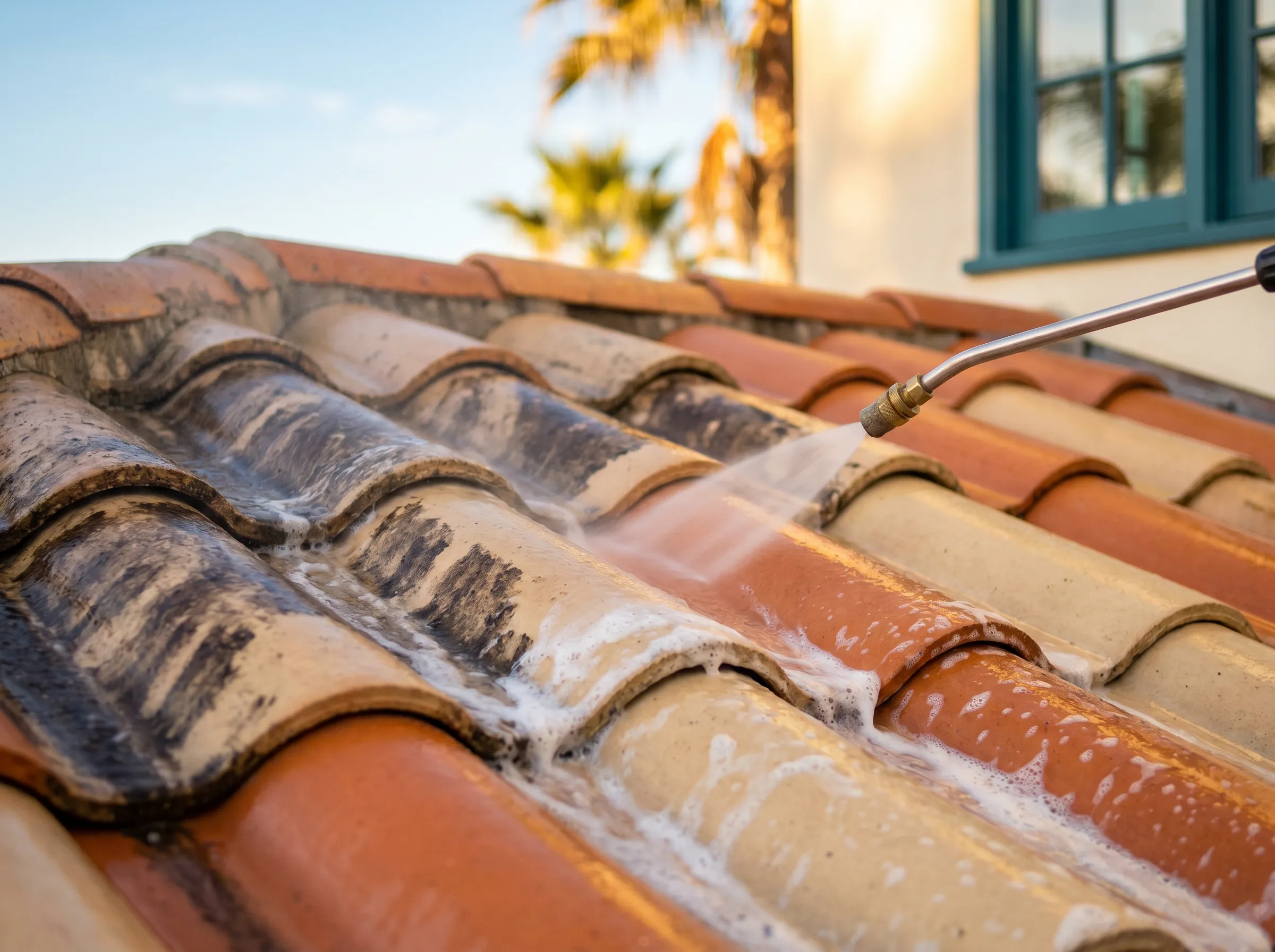
Soft washing swaps force for chemistry. Instead of high pressure, it uses a low-pressure application of cleaning solution — think closer to a garden hose than a power washer — that dissolves algae, mildew and mold at the root, dwells for a few minutes, and then rinses away clean.
Because it’s the solution doing the work rather than raw pressure, soft washing is safe for everything high pressure would damage: roofs, stucco, painted siding, wood soffits, screen enclosures and pool cages. And because it kills the growth rather than just knocking it off the surface, the results last much longer.
Why a roof should never be pressure washed
This is the one that costs people the most, so it’s worth being blunt: do not pressure wash a roof.
On a tile roof, high pressure can crack or chip tiles, blast out the mortar, and drive water up under the courses where it has no business going. On a shingle roof, it strips away the protective granules that give shingles their lifespan — you can literally see them wash into the gutter. On a metal roof, it can dent panels and force water past seams and fasteners.
And here’s the part that makes it worse: pressure washing a roof only removes the surface of the algae. The organism is still alive in the porous material, so the streaks come back fast — meaning someone paid to damage their roof and has to clean it again sooner.
The black streaks you see on Florida roofs are a hardy blue-green algae (its formal name is Gloeocapsa magma) that feeds on humidity and the limestone filler in shingles and tile. The only correct way to remove it is a low-pressure soft wash that kills it at the root. That’s exactly what our roof cleaning service is.
A simple rule of thumb
You almost never have to guess. Ask one question: is the surface hard and durable, or delicate and porous?
- Hard and durable — driveway, sidewalk, paver patio, pool deck, block wall at ground level → pressure washing.
- Delicate, porous or painted — roof, stucco, siding, soffit, screen enclosure, pool cage → soft washing.
When a home needs both — and most do — a good crew simply switches methods as they move around the property. A driveway gets pressure; the stucco above it gets a soft wash; the roof over all of it gets soft washed too.
“But my driveway has algae — which one?”
Good question, and it shows the rule isn’t only about the mess. A shaded driveway greening with algae is still a hard surface, so pressure washing is appropriate — but a soft-wash pre-treatment first makes it come cleaner and stay clean longer, because it kills the growth instead of just blasting the top layer. The best results often use both in sequence. For more on cadence, see how often you should pressure wash a house in Southwest Florida.
The takeaway
Pressure washing and soft washing aren’t competitors — they’re two tools for two kinds of surface. The trouble only starts when someone reaches for high pressure on something delicate, and a roof is the most expensive place to make that mistake.
If you’re not sure what your roof or exterior needs, call or text us. We’ll tell you honestly which method each surface calls for — and we’ll never point a pressure washer at something that can’t take it.